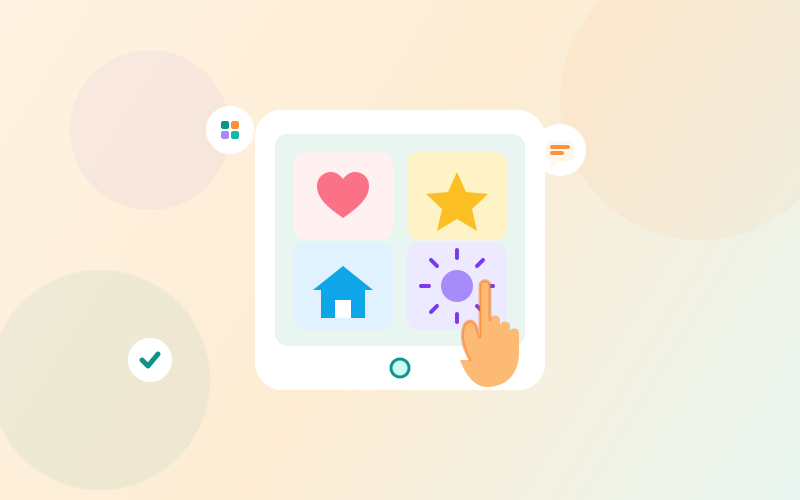
AAC: Augmentative and Alternative Communication
Équipe éditoriale Cabdivin
Équipe éditoriale Cabdivin
What is augmentative and alternative communication (AAC)?
Augmentative and alternative communication (AAC) refers to all the means — other than spoken language — that let a person express themselves, understand and be understood. According to ISAAC Francophone, a leading reference, AAC covers "all means of communication (other than oral speech) used to express thoughts, needs, desires and ideas."
- Alternative: when a person has no spoken language (or has lost it), AAC offers another channel.
- Augmentative: when speech exists but is insufficient or unclear, AAC supplements it.
AAC is not a single device but a toolkit adapted to each person. Our language disorders page places it within the wider field of speech therapy.
Who is AAC for?
AAC is for anyone whose spoken communication is absent, limited or hard to understand, at any age — for example:
- Autism spectrum disorder (ASD) when spoken language is absent or barely functional;
- Cerebral palsy and motor impairments that limit articulation;
- Profound multiple disabilities and rare genetic conditions;
- Neurodevelopmental disorders with delayed language;
- some severe acquired aphasias (for instance after a stroke).
AAC is not reserved for people with "no speech at all." It also helps those whose speech is fragile, fluctuating or unclear.
It can be temporary or lifelong. For autism specifically, see our speech therapy and autism / ASD hub and the dedicated care article.
What tools does AAC use?
Tools fall into two families: unaided (the body is enough) and aided (an object, image or technology). The right tool matches the person's abilities — which is why an assessment comes first.
| Family | Example tools | Key idea | |---|---|---| | Unaided | Gestures, gaze, sign language, Makaton | Always available | | Paper-based aided | Symbols, communication boards/books, PECS | Visual, concrete | | Tech-based aided | Tablet apps, speech-generating devices, eye-gaze | "Speaks" via a synthetic voice |
Makaton combines speech, signs and symbols — you speak while signing. PECS builds intent by exchanging a picture for an object. Tablets and speech-generating apps turn selections into an audible voice. None is "best" in absolute terms: they are chosen and often combined by the speech therapist.
Does AAC prevent spoken language? Debunking the myth
No. The fear that "giving pictures stops a child from talking" is the most common — and it is unfounded. AAC is designed to support speech, not replace it by default. As ISAAC Francophone notes, the "augmentative" dimension exists precisely to supplement speech that is underdeveloped or insufficiently clear. In 2026, France's national health authority (HAS) positions AAC as an essential pillar of autism support, introduced from the earliest stages and with no prerequisites. Acting early protects the development of communication.
The speech therapist's role and getting started
The speech therapist assesses, selects and personalizes the system, then supports daily use: a communication assessment, a realistic first tool, teaching and modeling ("I speak and I point"), gradual expansion and ongoing review. See our speech therapist for children page. Tracing goals and recording the tools used is essential — exactly what Cabdivin's patient record centralizes from one session to the next.
Involving the family and circle
AAC only works long-term if it leaves the therapy room: the person needs to communicate everywhere and all the time. The circle becomes a full partner — at home, at school and with relatives — and parent guidance helps families model communication without performance pressure.
FAQ
At what age can AAC start?
There is no minimum age and no prerequisite. It can begin as soon as a communication need appears. For autism, HAS recommends offering it from the earliest stages.
Is AAC only for people who do not speak at all?
No. It also helps people whose speech is insufficient or hard to understand — here it supplements speech rather than replacing it.
How do you choose between PECS, Makaton, symbols or a tablet?
There is no universal "best" tool: the speech therapist assesses, proposes a first system and adjusts it over time.
Cabdivin is software built for speech therapists — scheduling, patient records, AI-assisted reports and NGAP billing — to document AAC follow-up from session to session. Free trial, no credit card required.
Sources
- ISAAC Francophone — Association internationale pour la communication alternative et améliorée
- ISAAC Francophone — Le mois international de la CAA : un plaidoyer pour la communication alternative et améliorée
- Haute Autorité de Santé — Trouble du spectre de l'autisme : interventions et parcours de vie du nourrisson, de l'enfant et de l'adolescent (2026)
- Mon Parcours Handicap (service public) — Glossaire : CAA (communication alternative et améliorée)
- Enfant Différent (association Une Souris Verte) — La communication alternative et améliorée (CAA)
Join the practitioners using AI daily
Cabdivin helps you manage your practice in minutes, not hours. Focus on your patients, not paperwork.
About the author
Équipe éditoriale Cabdivin
Équipe éditoriale Cabdivin
The Cabdivin team creates content to help healthcare professionals optimize their daily practice.
Manage your practice 5x faster with AI
Cabdivin automates your reports, billing and scheduling. Join practitioners saving time every day.
Try for freeFree for 7 days • No commitment
Categories
Newsletter
Get our practical tips and the latest news.