Hearing aids: types, how to choose and the adaptation period
Signs of hearing loss, the path from ENT to audiologist, device families (BTE, RIC, in-the-ear) and the adaptation period: a clear guide to hearing aids.
Practical resources for healthcare professionals: AI tools, practice management, billing, assessments and telehealth.
Signs of hearing loss, the path from ENT to audiologist, device families (BTE, RIC, in-the-ear) and the adaptation period: a clear guide to hearing aids.
Orthotic insoles can relieve foot, knee or back pain. The podiatric assessment combines a static exam, gait analysis, custom manufacture, follow-up and renewal.
A midwife can follow a low-risk pregnancy from start to finish: monthly prenatal consultations, reference ultrasounds, birth preparation and postnatal care, with referral to an obstetrician if a risk appears.
Dressings, injections, infusions, monitoring, hygiene care: which nursing acts are done at home, on what prescription, and how an independent nurse organises the care round.
Oral health prevention explained: how plaque becomes tartar then decay, gingivitis and periodontitis, daily habits, scaling and the signs that should prompt a dental visit.
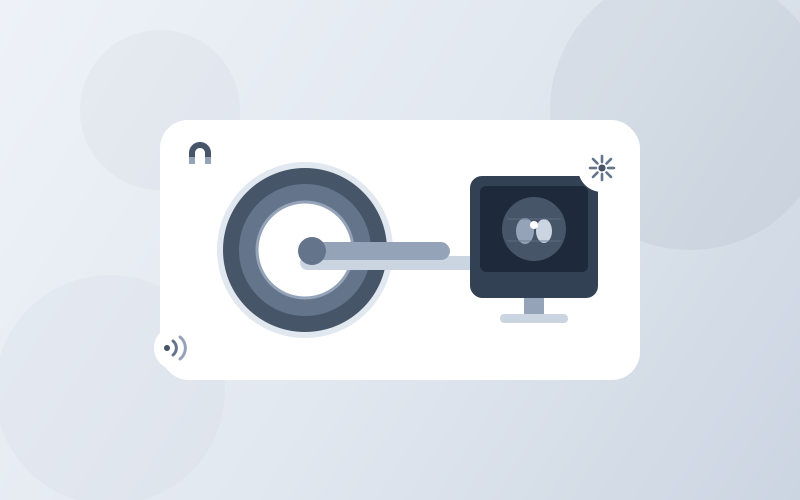
X-ray, CT, MRI or ultrasound: understand the principle, uses and limits of each medical imaging exam to know which one fits which situation.
Illegible, slow or painful writing? Understand graphomotor skill (the gesture), how it differs from written language (speech therapy) and how it is helped.
The occupational therapy assessment captures independence in real life: goals, methods (interview, observation, ecological tasks), tools (FIM, COPM) and reporting.
Gynaecological follow-up supports genital and breast health throughout life: consultation, cervical smear and HPV test, palpation, breast imaging and organised screening, explained simply.
Childhood myopia progresses while the eye grows: warning signs at school, ophthalmology screening, the role of outdoor time and screens, and myopia-control methods.
Undernutrition in older adults is frequent and under-diagnosed. Warning signs, screening by weight and the MNA, and the key principles of management.
Understand systolic and diastolic pressure, why hypertension is silent, how to practise home monitoring with the rule of three, and when to see a cardiologist.
Video consultation in general practice: how a remote appointment unfolds, which reasons suit it or need an in-person exam, e-prescriptions and its place in the care pathway.
What are standardised scales like the PHQ-9 and GAD-7 for? Screening, longitudinal follow-up, limits and precautions: a practical overview for psychologists.
Sleep apnoea (OSAHS) combines snoring, night-time breathing pauses and daytime sleepiness. Warning signs, diagnosis by polygraphy or polysomnography, and the main treatment families: lifestyle, CPAP and oral appliances.
Fever in children: the right comfort measures, the warning signs, and when to see a doctor — including the under-3-months infant rule.
Common low back pain or a warning sign? Why to stay active, avoid prolonged rest, and when physiotherapy steps in to ease pain and prevent recurrence.
Osteoarthritis is more than age-related wear: understand cartilage, tell osteoarthritis from arthritis, spot knee and cervical forms, and rely on adapted physical activity.
TSH is the key test in a thyroid panel. What it measures, why a high TSH points to hypothyroidism, and why a single value is never enough on its own.
Clumsiness, restlessness, handwriting or attention difficulties: when to consider a child's psychomotor assessment, what it explores and how it unfolds.
Acne is not a hygiene problem but a skin mechanism. Myths, mild-to-severe gradation, when to see a dermatologist, and tracking progress with photos.
Irritable bowel syndrome (IBS) combines abdominal pain, bloating and altered bowel habits with no lesion: symptoms, alarm signs and management.
The initial nutritional assessment is the foundation of dietetic care: dietary history, measurements, realistic goals and a personalised follow-up plan.
What osteopathy can and cannot treat, how a session unfolds (history, tests, techniques), and when back pain calls for seeing a doctor first.
The orthoptic assessment evaluates how the two eyes coordinate and hold up: screen fatigue, a schoolchild's headaches, DYS workups, strabismus and convergence insufficiency. Indications, procedure and rehabilitation.
Choosing your setting, respecting professional ethics and confidentiality, setting fees and getting known: a practical guide to starting out as a private psychologist.
Psychiatrist, psychologist, psychotherapist: training, prescribing, type of care. Understand the difference to know when to consult about mental health.
A child psychiatrist supports a child's mental health: which signs warrant attention without alarm, how a first consultation unfolds, and the parents' role.
The physiotherapy diagnostic assessment (BDK) shapes rehabilitation: history, range of motion, muscle testing, functional scales and a summary for the doctor.
Occupational therapy helps children gain independence at home and school: what the therapist does, warning signs, classroom adjustments and coordinating care.
Pragmatics is the social use of language. Definition, signs, the DSM-5 social (pragmatic) communication disorder, its links with autism, and the speech-language assessment and intervention.
Dyslexia does not vanish in adolescence — teens learn to compensate. How it shows up in middle and high school, school accommodations, digital tools, and the role of the speech therapist.

Phonological awareness — hearing and manipulating the sounds of language — is one of the strongest predictors of learning to read. Definition, age stages, concrete games, and early identification.
Language immersion, shared reading, positive recasting, play: simple, kind everyday habits that support your child's speech therapy alongside professional care.
Augmentative and alternative communication (AAC) supplements or replaces speech. Who it's for, which tools (PECS, Makaton, symbols, tablets), and why it supports spoken language rather than holding it back.
Dysarthria is a neurological motor speech disorder, distinct from aphasia. Causes, signs, assessment and speech therapy techniques explained.
Why and when to see a speech therapist when living with Parkinson's disease: dysarthria, soft voice, swallowing difficulties, the LSVT LOUD method and long-term follow-up.
Why speech therapy matters in Alzheimer's disease, what the speech therapist actually does for communication and swallowing, and how families are supported. A caregiver guide.
Understand the Borel-Maisonny method: its gestural and phonetic principle, who it is for, how the work unfolds, and what research really says about its effectiveness.
Worried that growing up with two languages is delaying your child's speech? Bilingualism does not cause language disorders. Here is how to tell a normal difference from a real warning sign.
Food refusal, extreme selectivity, sensitivity to the spoon: understanding pediatric feeding disorder, its signs, its causes and the role of the speech therapist.
Understanding childhood hearing loss, its screening, degrees and speech therapy support: auditory education, oral language, hearing aids and cochlear implants, parental guidance.
Definition, three pillars, levels of evidence, databases and clinical application: how to integrate EBP into your speech therapy practice, including structured patient data tracking.
Test-teach-retest, mediation, reduced cultural bias: how dynamic assessment complements norm-referenced batteries to tell language difference from disorder in children.
Teacher, trainer, singer or voice professional? Learn the principles of vocal hygiene to prevent vocal strain: hydration, warm-up, vocal rest, noise management and the warning signs to know.
After a total laryngectomy the laryngeal voice is gone, but speech can return. Esophageal voice, voice prosthesis, electrolarynx: a clear, compassionate look at vocal rehabilitation and the speech therapist's role.
Is your child simplifying words or hard to understand? Learn about developmental milestones and when a speech therapy assessment is recommended.
Administrative steps, office selection, management software, registration: everything you need to know to open your private speech therapy practice.
Detailed comparison of speech therapy software in 2026: Cabdivin vs Doctolib vs Weda vs Orthoscribe. Features, pricing, pros and cons.
How to recognize signs of dyslexia, when to consult a speech therapist, and what does the assessment include? Complete guide for parents and professionals.
Complete guide on stuttering: understand the causes, recognize warning signs and discover effective speech therapy treatments for children and adults.
Understanding NGAP coding to correctly bill your speech therapy assessments and sessions in private practice.
Dysphagia in adults and children: causes, assessment and speech therapy rehabilitation. Complete guide for professionals and patients.
Everything about voice disorders: functional dysphonia, nodules, polyps. Voice assessment and rehabilitation techniques.
From automated report generation to smart scheduling, discover how AI is revolutionizing every aspect of speech therapy practice in 2026.
VEGA, Docorga, myCR, Cabdivin… Which software to choose in 2026? Detailed comparison of features, pricing, and AI integration.
Discover how Cabdivin's AI generates structured assessment reports in minutes, with EVALO, ELO, N-EEL, and EXALANG tests built in.
Complete guide on post-stroke aphasia: types, assessment, speech therapy techniques and language recovery prognosis.
How to set up SESAM-Vitale electronic claims in speech therapy practice: card reader, approved software, electronic care sheets and third-party payment.
Gamification, digital tools, voice AI, parent involvement… Discover the innovative approaches transforming pediatric speech therapy.
The speech therapist's role in autism spectrum disorders: communication assessment, PECS, MAKATON and naturalistic approaches.
How much does a speech therapy session cost? What reimbursement from Social Security and health insurance? Complete 2026 guide.
Discover how artificial intelligence is revolutionizing report writing, patient tracking, and therapeutic planning.
Sigmatism, rhotacism, lisping: understanding articulation disorders in children, when to consult and what speech therapy exercises to correct pronunciation.
How to manage patient records in speech therapy practice: mandatory content, retention period, GDPR, consent and health data security.
Everything you need to know to launch your telehealth sessions: legal framework, best practices, and adapted tools.
The best strategies to automate billing, manage your schedule, and save time every day.
Patient flow, scheduling, records, digital tools… The keys to efficiently organizing your speech therapy practice and gaining peace of mind.
Save hours every month with automated billing. From third-party payments to payment reminders, everything you need to know.
Manual or automated billing, third-party payments, electronic claims… Everything a private speech therapist needs to know about efficient billing in 2026.
Administrative burden, isolation, overwork: discover concrete strategies to preserve your professional balance.
Digital games, augmented reality, and AI: how new technologies are transforming child speech therapy.
72 articles
Cabdivin automates your reports, billing and scheduling. Join practitioners saving time every day.
Try for freeFree for 14 days • No commitment
Get our practical tips and the latest news.
Our new practical articles (assessments, NGAP coding, practice management) straight to your inbox.
No spam. Unsubscribe in one click.